
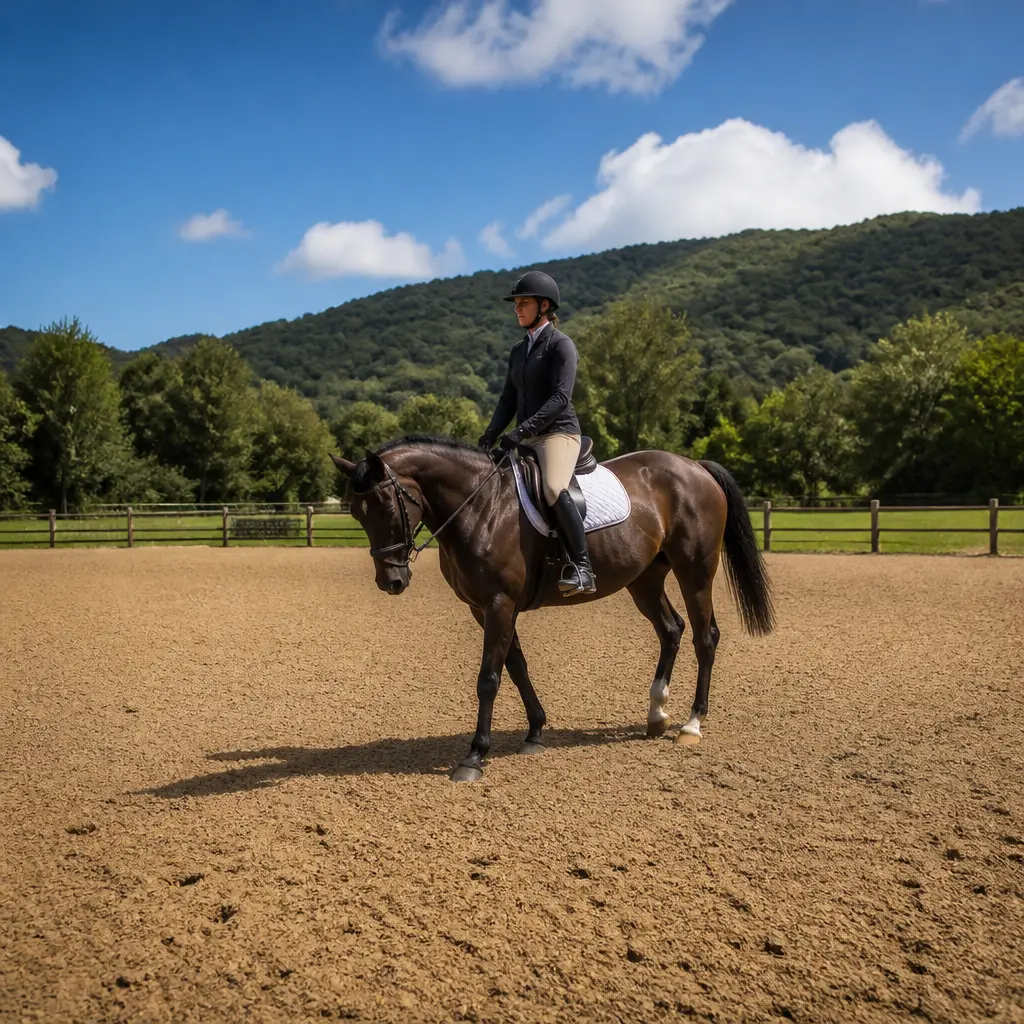
Flat-ground fundamentals, commonly called flatwork, are the basic riding skills developed without jumps or complex obstacles: balanced posture, effective aids, rhythm, steering, transitions, stopping, and safe horse management. They are the foundation of safe riding because a rider who can regulate pace, maintain an independent seat, and communicate clearly is better prepared for spooks, refusals, uneven footing, and unexpected movement. The British Horse Society and the United States Equestrian Federation both place control, balance, communication, and appropriate protective equipment at the center of responsible riding. Although jumping and trail riding receive more attention, most practical safety begins with disciplined work on the flat.
Flat-Ground Fundamentals Build Riding Control
Flat-ground fundamentals are the systematic exercises used to improve the horse’s balance, responsiveness, suppleness, and obedience while the rider develops a stable and independent position. The International Federation for Equestrian Sports describes dressage, the most formal expression of flatwork, as the harmonious development of the horse through communication, balance, and controlled movement. In everyday riding, the same principles apply even when the goal is hacking, ranch work, rehabilitation, or jumping preparation.
The central safety characteristic is controllability. A horse does not need to perform advanced movements to be safer; it needs to respond reliably to basic requests such as slow down, stop, turn, yield, and stand. These responses are developed through related hyponyms of flatwork, including groundwork, leading, mounting practice, walk–halt transitions, trot control, steering exercises, lateral work, desensitization, and emergency dismount preparation.
Balance and the Independent Seat
An independent seat is the rider’s ability to maintain balance without gripping the reins or destabilizing the horse. It coordinates the pelvis, legs, torso, and hands so that the rider can absorb movement while giving clear aids. The British Horse Society identifies correct position and balance as essential components of effective riding because a tense or unstable rider can unintentionally accelerate, turn, or confuse the horse.
Flat-ground exercises make this skill measurable. Riding frequent transitions between halt, walk, and trot exposes whether the rider can remain centered when the horse changes rhythm. Large circles and straight lines reveal unequal rein contact, collapsing hips, or a tendency to lean. Short periods of riding without stirrups can develop stability, but they should be introduced gradually and under supervision because fatigue can create a new safety risk.
Rhythm, Tempo, and Transitions
Rhythm is the regular sequence of the horse’s footfalls, while tempo is the speed of those footfalls. A safe rider learns to preserve a calm, consistent tempo rather than allowing the horse to rush, lose impulsion, or become inattentive. Transitions are the practical test of this control: walk to halt, halt to walk, walk to trot, and eventually transitions within a gait.
These exercises matter outside the arena. On a trail, a reliable downward transition can prevent a horse from accelerating toward a gate, another horse, or insecure footing. In a jumping environment, balanced flatwork helps the horse approach an obstacle at a manageable pace. The United States Equestrian Federation’s training principles emphasize progressively developing responsiveness rather than demanding speed or complexity before basic control is established.
Steering, Stopping, and Directional Control
Directional control is the ability to guide the horse accurately using coordinated reins, legs, seat, and vision. It includes turning, changing the size of a circle, riding straight lines, yielding from leg pressure, and halting without drifting. Steering should not depend entirely on pulling both reins because excessive rein pressure can make a horse brace, lose balance, or ignore more precise signals.
A practical validation exercise is the emergency-style halt from a controlled walk or trot. The rider should be able to close the legs for balance, sit deeper, use the reins evenly, and release when the horse stops. Repeating this exercise in a calm setting builds a response that may be valuable when a gate opens, equipment fails, or a horse becomes distracted. It also shows why flatwork is more than appearance: it establishes usable responses under pressure.
Flat-Ground Fundamentals Improve Horse Communication
Communication in riding is a coordinated system of aids rather than a single rein action. The horse interprets the rider’s seat, legs, hands, posture, voice, and timing. Clear communication depends on consistency: a signal should have a recognizable meaning, an appropriate level of pressure, and a release when the desired response occurs.
Leg, Seat, and Rein Aids
Leg aids generally influence forward movement, bending, and lateral positioning; seat aids influence balance, tempo, and transitions; rein aids refine direction and speed. These categories overlap, so effective riding is not mechanical. For example, a downward transition may require the rider to stabilize the torso, close the fingers, and stop driving with the seat rather than simply pulling.
Flatwork allows riders to isolate and recombine these aids. A leg-yield exercise teaches the horse to move away from pressure without rushing. Serpentines test changes of bend and rein coordination. Halt–walk transitions test timing. When an instructor can identify which aid produced a response, training becomes more predictable and less dependent on force.
Suppleness and Lateral Movement
Suppleness is the horse’s ability to bend through the body and move joints freely without tension. Basic lateral exercises include leg yield, shoulder-fore, turn on the forehand, and correctly shaped circles. These movements are not merely dressage decorations; they help the rider manage the horse’s shoulders, hindquarters, and line of travel.
Improved suppleness can make changes of direction smoother and reduce the likelihood of abrupt loss of balance. However, lateral work must remain appropriate to the horse’s training and physical condition. The Fédération Equestre Internationale stresses progressive gymnastic development, and veterinary guidance is appropriate when stiffness, unevenness, or resistance persists.
Groundwork and Desensitization
Groundwork is training conducted from the ground, including leading, yielding the hindquarters, backing, standing, and responding to pressure-and-release signals. Desensitization is the gradual introduction of harmless stimuli, such as a tarp, umbrella, noise, or moving object, while maintaining the horse’s attention and a safe distance.
These practices connect directly to mounted safety. A horse that understands personal space and responds to a handler’s request to stop is easier to manage during tacking, loading, veterinary care, and mounting. Desensitization should not mean overwhelming the animal. The goal is controlled habituation, with the handler able to retreat, pause, and reward calm behavior before increasing difficulty.
Flat-Ground Fundamentals Reduce Preventable Riding Risk
Horse riding carries inherent risk because the rider is elevated above the ground and depends on a large, responsive animal. Injury surveillance from the U.S. Consumer Product Safety Commission and the Centers for Disease Control and Prevention has repeatedly identified falls and collisions as important mechanisms in equestrian injuries. Research summarized in the medical literature has also associated certified equestrian helmets with substantially lower risk of head injury, making protective equipment an essential companion to training rather than a substitute for it.
Controlled Progression Before Jumping or Speed
Controlled progression means increasing difficulty only after the horse and rider can perform the current task consistently. A sensible sequence may move from groundwork to mounted walking, then to transitions, steering, trot work, poles, small obstacles, and eventually more demanding jumping or faster riding. The exact sequence depends on age, experience, fitness, temperament, and environment.
A rider who cannot maintain a balanced seat during a simple trot transition is not prepared to correct a poor jump approach. Similarly, a horse that rushes through a circle or ignores a downward transition may be unsafe over fences or on an open trail. Flatwork provides a low-complexity environment in which these weaknesses can be identified before they are amplified by height, speed, or unfamiliar terrain.
Emergency Responses and Risk Management
Emergency preparation includes recognizing loss of control, creating space, stopping when possible, and dismounting safely when remaining mounted is more dangerous. Riders should practice ordinary responses such as an emergency halt and controlled turn before attempting simulated emergencies. A qualified instructor can also teach a one-rein emergency turn where appropriate, but this technique must be introduced carefully because incorrect use can unbalance or frighten the horse.
Risk management also includes checking tack, footing, weather, visibility, arena fencing, and the experience level of the horse-and-rider pair. The American Society for Testing and Materials establishes performance standards for equestrian helmets, while safety organizations commonly recommend replacing a helmet after a significant impact even when no damage is visible. Safe flatwork therefore combines technical riding with equipment inspection and environmental judgment.
A Practical Flatwork Checklist
- Confirm that the horse is physically comfortable and that the tack is correctly fitted.
- Wear a properly fitted, certified equestrian helmet and suitable footwear with a defined heel.
- Begin with groundwork or a calm mounting routine when conditions require it.
- Establish walk rhythm, steering, halt, and rein contact before asking for more speed.
- Practice transitions and changes of direction on both reins without rushing.
- Use short, clear aids and release pressure when the horse responds.
- Stop the session when fatigue, tension, pain, or loss of concentration appears.
Flat-Ground Fundamentals Apply Across Riding Disciplines
Flatwork is shared by dressage, show jumping, eventing, hunting, western riding, mounted games, endurance, and recreational trail riding. The terminology changes, but the underlying needs remain similar: a responsive horse, a balanced rider, predictable transitions, accurate steering, and the ability to remain calm when conditions change.
For example, a trail rider may use shoulder control to keep a horse away from a drop-off, while a show jumper uses the same foundational balance to regulate the approach to a fence. A western rider may practice stops and turns for ranch work, while a dressage rider refines them through formal movements. These are different applications of the same safety principle: reliable control should be trained before it is urgently needed.
A useful training record can include the horse’s rhythm, response to transitions, steering accuracy, tension level, and recovery after exercise. A simple chart comparing these measures across several sessions can reveal progress more accurately than a single successful ride. Instructors, veterinarians, and qualified behavior professionals can help distinguish a training problem from pain, fear, unsuitable tack, or physical limitations.
Conclusion: Flat-Ground Fundamentals Are the Safety Base
Flat-ground fundamentals provide the practical foundation for safe horse riding. Balance creates an independent seat; rhythm and transitions establish speed control; steering and stopping improve directional safety; groundwork strengthens communication; and progressive flatwork prepares horse and rider for jumping, trails, competition, and unexpected events. Research and safety guidance consistently support the combined use of sound training, certified protective equipment, appropriate supervision, and thoughtful risk management.
Riders should treat flatwork as core training rather than a preliminary task to rush through. Build sessions around calm responses, accurate transitions, and gradual progression, and seek feedback from a qualified instructor. Further reading from the British Horse Society, the United States Equestrian Federation, the Fédération Equestre Internationale, and established medical and safety organizations can help riders create a program suited to their horse, discipline, and experience.
Sources: British Horse Society, Riding and Horse Safety Guidance, https://www.bhs.org.uk/; United States Equestrian Federation, Rules and Safety Resources, https://www.usef.org/; Fédération Equestre Internationale, Dressage and Training Principles, https://www.fei.org/; U.S. Consumer Product Safety Commission, Horseback Riding Injury Data and Safety Information, https://www.cpsc.gov/; Centers for Disease Control and Prevention, Traumatic Brain Injury and Injury Prevention Resources, https://www.cdc.gov/; American Society for Testing and Materials, ASTM F1163 Standard Specification for Protective Headgear Used in Horse Sports and Horseback Riding, https://www.astm.org/
